




Biking the Stars
ways on wheels. Being an artist, he has built the bikes he travels with himself. As his
daughter, I got curious to learn more about his journey, foreseeing a future that is
filled with even more journeys ahead. ‘When I’m on the road, I feel at home
everywhere.’
My father has built various bikes, from scratch. He has succeeded in building ones that last
beyond decades. Asking him the way this pastime came to be, he told me it has got to be
linked to his childhood. His love for cycling didn’t come from nowhere. His father—my
grandfather—was a bike mechanic. He never built a bicycle from scratch, but he knew how
to fix one. That craft, that way of working with his hands, lives on in Wilfried.
‘I have an atelier, just like your grandfather did. One day, when your mother and I had just
moved here, an acquaintance visited with a recumbent bike. I didn’t even know they
existed, and he said it was self-made. I quickly realized it was possible. I learned to ride it
and was hooked.’
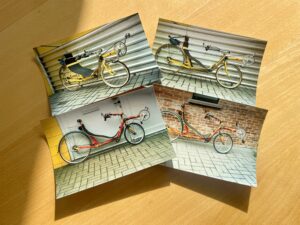
The recumbents Wilfried built himself. Photo: © Aerin Thijs
He built his first recumbent bike, rode it to work, then built and sold two more. Now, his
latest creation, a tandem bike called a Pino, carries him on new adventures. Even now, he
keeps old bike parts, just in case. ‘I probably won’t build another,’ he says, ‘but you never
know. Just for fun.’
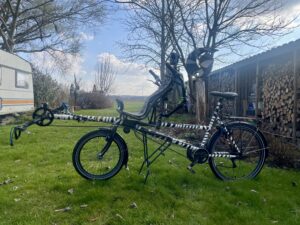
The tandem – Pino – he built himself. Photo: © Aerin Thijs
Cycling to France
In 1993, my father and grandfather travelled 2,400 kilometers to Santiago de Compostela. It took them just 12 days.
‘Your grandfather wasn’t as fierce as I am,’ my father says with a smile. ‘He cycled, yet, had no luggage. I followed in a van—cooking, washing his clothes, finding places to sleep. I even washed his feet. Literally. If only he could see me now.’
Last year, on a trip to the Pyrenees, my father planned his route through France. But Paris was closed for the Olympics, so he had to change course. That’s when he saw the name: Rozoy-sur-Serre.
‘Our first stop, unplanned, had been Rozoy-sur-Serre. And there it was again, 30 years later. The next day, I cycled 200 kilometers straight there. I set up my tent in the exact same place.
Can you see me here, father? I wondered.
That journey with your grandfather was always with me. I passed places we had been, I retraced our path. Maybe I was trying to catch up with him.’
Challenges on the road
Something I’ve always admired about my father is his boldness to pave the roads by bike, in a manner as unprepared as his.
‘You get on your bike, you start riding, and you’ve got no idea what’s ahead. You’ve got some sort of direction, but you’ve got no idea where you’ll sleep, what you’ll eat, who you’ll come across. All is unplanned, a mystery. People wonder if I got to see landmarks or places of importance. I see things most people don’t. I find streams of rivers or pockets of forests whenever I take the roads less travelled.’
Not every night on the road is easy. Sometimes, finding a place to sleep is a challenge. One evening, deep in France, my father thought he had found an abandoned house. Exhausted, he cooked in the garden, ate, and prepared to settle in —until he noticed signs of life. Shoes by the door. Clothes hanging inside. Someone still lived there.
‘I left quickly, not wanting to disturb anyone. I rode on, unsure where I would sleep. Then I reached Brantôme, in the Dordogne. It was late, and I found a small, hidden campsite. Wooden beams, tipis, and caravans surrounded a long tree-lined driveway leading to a terrace. A woman was singing ‘Je vois la vie en rose.‘ It felt like she was singing just for me.’
There, he met a kind family who offered him a spot for his tent. They fed him pizza, fries, and beer—a luxury after days of water and simple food. The next morning, a couple from Bruges invited him for coffee, and they spent the day swimming together. That night, he lay in his tent and listened to wolves howling in the distance.
‘These moments find you when you least expect them. That’s why I travel. The road gives you what you need.’
Dreaming of Isfahan
Wilfried’s longest journey is still ahead. He dreams of cycling to Isfahan, Iran—5,000 kilometers away. Not for its beauty, nor for its history, but because of a poem: The Gardener and Death by P.N. Van Eyck.
‘I first read the poem when I was 20. It’s about a servant who tries to escape death by fleeing to Isfahan—only to find Death waiting for him there.
That’s life, isn’t it? You think you’re running towards something, but maybe it was always going to find you. That’s why Isfahan calls to me.’
He traces his imagined route: through Ukraine, across the Black Sea, into Georgia, Turkey, and finally, Iran.
‘I would leave without knowing exactly which way I’d go. But I know I’d get there.
Isfahan is incredible. The Silk Road, the cradle of culture, Mesopotamia. And much more confronting than now because, thus far, I’ve only cycled within Europe. Once you cross into Turkey and beyond, you have to make do and knock on people’s doors, ask if you can have some water, a date, or bread. But it will work out. I know it will.
Arriving in Isfahan won’t be special. I’ll stay for a day, then leave. Because it isn’t about the destination. It’s about the journey—and the roads that will shape me along the way.’
The eternal ride
My father is not just a traveller, not just a cyclist. He is a man who moves forward, even when he isn’t sure what he’s chasing.
Maybe he is chasing freedom. Maybe he is chasing memories. Maybe he just wants to see the world as it is—unfiltered, raw, and real.
He rides into the unknown. And maybe that’s where he feels most at home.