



PORTRAITS FROM ROMANIA – Emotions without faces: Andrei Budescu on the coherence between feelings and art
Budescu has spent over two decades tracing the subtle vibrations of life through experimental innovative art. His journey is a curiosity and emotional depth, shaped by a desire to explore what lies beneath the surface. Now, as both artist and educator, he invites others to look beyond the visible and listen to the silence in between.
By Kiki-Jane van Iterson, Loekie Pruijn, Karolina Rybarczyk and Viggo Goris
43-year-old Andrei Budescu’s artistic journey began long before the digital age transformed photography. Growing up in Iasi in socialist Romania, film photography was still the only option and technological resources were limited. Budescu’s fascination with capturing images emerged early and naturally. ‘It wasn’t expensive back then,’ he recalls, ‘but it was also just the only way to do it.’ He taught the basics of black-and-white and colour film. He quickly found himself drawn, not only to photography but to every form of visual expression he could explore. Such as graphic design, video and installations. This hunger for experimentation deepened during his studies at the Art University in Cluj-Napoca, a city he chose for its creative potential and where he lives, teach, and push the boundaries of art today.
BLURRY FACES, PERSISTENT MEMORY
‘I found those pictures on a flea market in Germany’, he says. ‘They are family pictures on which I did interventions to adept them to the memory erasing theme.’ In his most recent work Budescu worked on remembering the Holocaust. This was one of his most affecting projects. He intervened in the photos by partially obscuring faces and fading details. ‘It was about erasing identity,’ he explains, drawing a direct line between the Holocaust’s systematic destruction of culture and his own artistic process. The altered photographs became symbols of what the Holocaust attempted to obliterate not only lives, but memory itself. His work invites viewers to witness this absence, to feel the disorientation of fragmented memory, and to reflect on what it means when a person’s existence is reduced to something disposable.
The project was part of a group exhibition, launched on Holocaust Remembrance Day, with the explicit intention of raising awareness through artistic interpretation. Budescu emphasizes that this was a collective act of commemoration. ‘We tried to do it through the whole project,’ he says, ‘to make people remember or at least start asking questions.’ For younger audiences especially, who often experience this history only as distant facts, the exhibition aimed to create an emotional entry point into a subject that resists simplification. The tension between personal expression and historical responsibility is something Budescu also explores in his teaching. He encourages his students to engage with difficult subjects by first mastering the fundamentals composition, technique, narrative and then pushing beyond them to find their own voice. ‘Artists need freedom,’ he says. ‘But they also need purpose. You have to know the rules so you can break them meaningfully afterwards.’ In both his art and pedagogy.
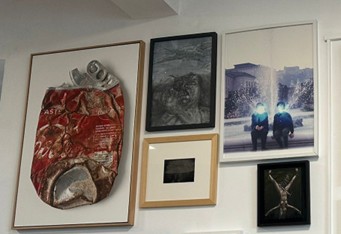
Right above: One of the pictures from the flea market after Budescu’s intervention © Karolina Rybarczyk
WHERE THE SEA DOESN’T END
‘It was very human what they were feeling.’ For Andrei Budescu, the essence of life is not captured in a single image, but in the atmosphere of an entire installation. In the recent exhibition [IN]ABSENTIA he explored these feelings. He created a deeply immersive video work that became the emotional centre of the experience. ‘I started from a photo of mine and then developed it into a slow-motion video using AI, which wasn’t as easy as it sounds.’ With its natural scale and enveloping sound, the piece was designed to draw viewers in physically and emotionally, letting them find their own interpretation within the rhythms of nature. The mixed reactions weren’t a flaw, he insists they were the point.

This emotional ambiguity is central to Budescu’s broader artistic philosophy. He isn’t interested in delivering a fixed message or dictating meaning. Rather, he invites viewers to bring their own experiences and sensibilities to the work. ‘People are drawn to uncertainty,’ he says. ‘They’re curious about what’s beyond the surface. I am too.’ The contrast between this piece and earlier works such as his Holocaust photo interventions is stark but deliberate. ‘The photos are more meant to confront the traumas in a conceptual framework, the video installation is way different as it is more abstract, poetic realm.’ He explains. ‘It’s supposed to make you feel something without knowing exactly why, the personal mystery is where art lives.’
BACK TO THE ROOTS & NEW PATHS
Looking ahead, Budescu sees the future of art not as a single path. He’s drawn to the rise of interactive art, where viewers can step inside the work and even become co-creators. ‘It’s a gateway,’ he says, ‘especially for people who feel distant from art it brings them closer.’ Yet, while he embraces new forms, his dreams also point back to the tactile origins of his practice: hand-printing black-and- white photographs. In all these plans, whether high-tech or handmade, He concludes: ‘My vision is to create spaces where emotion, curiosity and connection can unfold at their own pace and in their own form.’